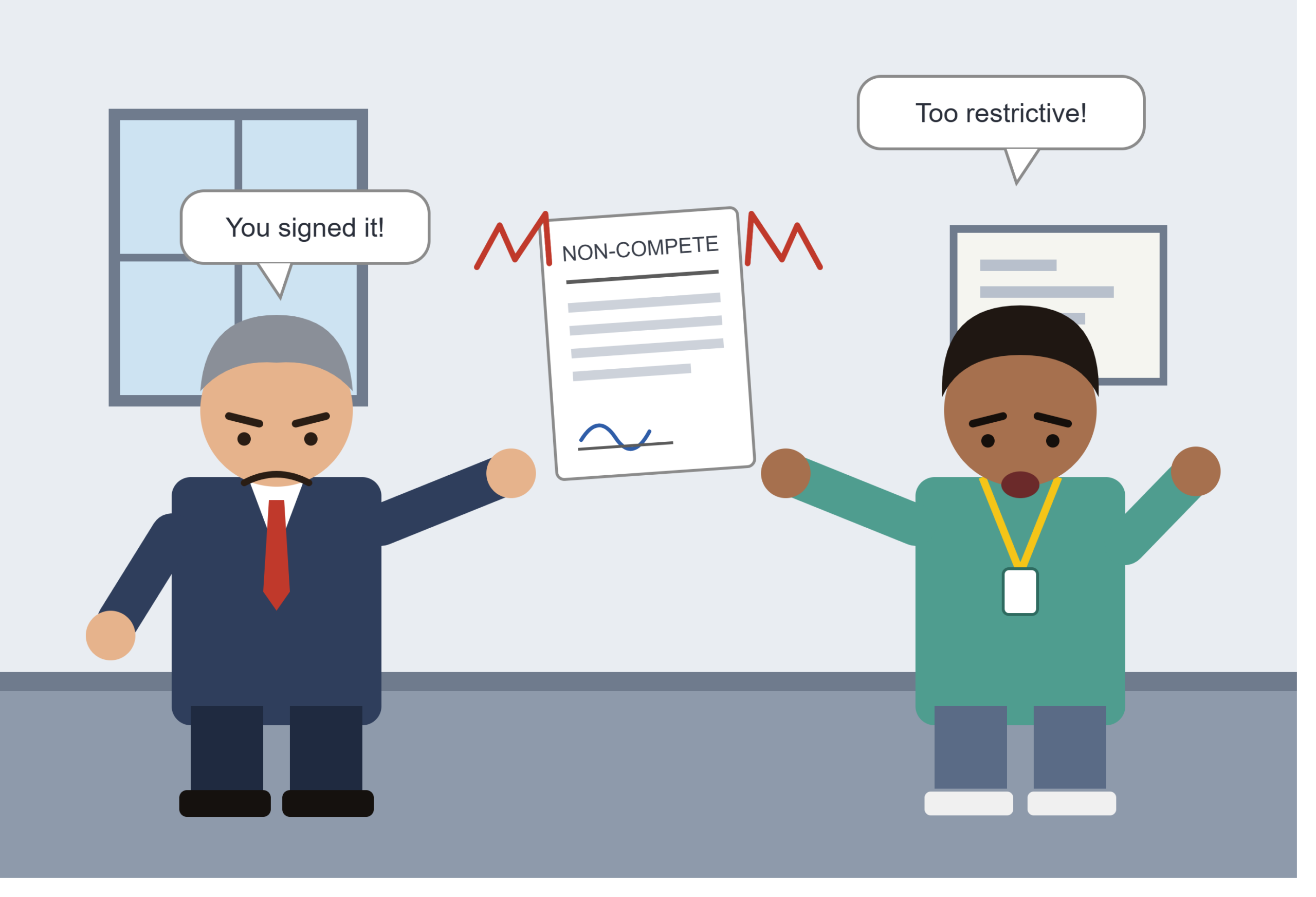
If you’ve ever signed an employment contract in North Carolina, there’s a good chance you’ve encountered a non-compete agreement, sometimes called a restrictive covenant. These clauses typically prevent an employee from working for a competitor or starting a competing business within a certain geographic area for a set period after leaving a job. Employers use them to protect trade secrets, client relationships, and other legitimate business interests. But because they also limit a worker’s ability to earn a living, North Carolina courts scrutinize these agreements closely, and they are far from automatically enforceable just because an employee signed one.
For a non-compete to hold up in North Carolina, it generally must meet several requirements: (1) it must be in writing; (2) part of an employment contract; (3) supported by valid consideration (something of value exchanged, such as a job offer or a raise); (4) designed to protect a legitimate business interest; and (5) reasonable in both time and territory.
Time and geographic restrictions are usually where non-compete disputes are won or lost. North Carolina courts generally favor restrictions of two years or less, though shorter periods are viewed even more favorably, and anything longer invites heightened scrutiny. Geographic scope must be tied to where the employer actually does business or where the employee had meaningful contact with clients; a restriction covering the entire state, or even multiple states, is much harder to justify for a local business than it might be for a company with a genuinely broad footprint. Courts weigh the two restrictions together, so a longer time period paired with a narrow territory might be reasonable, while a short duration paired with an enormous territory could still be struck down.
One of the most distinctive features of North Carolina law as it relates to non-competes is the “blue pencil rule.” Under the blue pencil rule, a court may strike out unreasonable or overly broad language, but it cannot add new terms or rewrite the provision to make it enforceable. In practice, this means a judge can delete an entire unreasonable restriction, such as a whole geographic territory listed in a contract, but cannot narrow that territory to something more reasonable on the employer’s behalf. This makes drafting precise, reasonable language from the outset especially important for employers in the state.
For employees, the key takeaway is that a non-compete agreement in North Carolina is not automatically binding just because it’s in a signed contract. For employers, the lesson is that overly aggressive drafting can backfire, since the blue pencil rule offers little room for judicial rescue if a provision goes too far. Anyone facing a non-compete dispute, whether as an employer trying to protect their business or an employee weighing a new job opportunity, should consult with an attorney familiar with North Carolina employment law, since the reasonableness of any given agreement depends heavily on the specific facts involved.